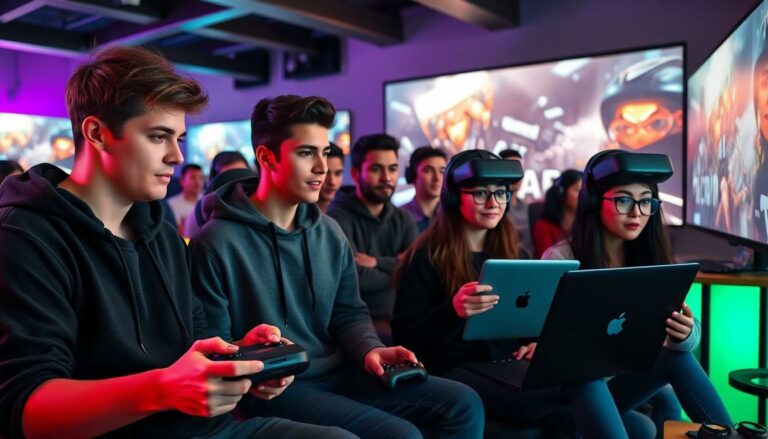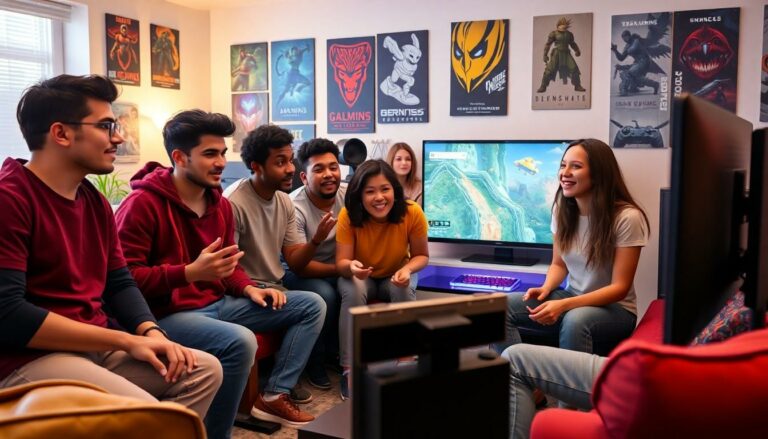
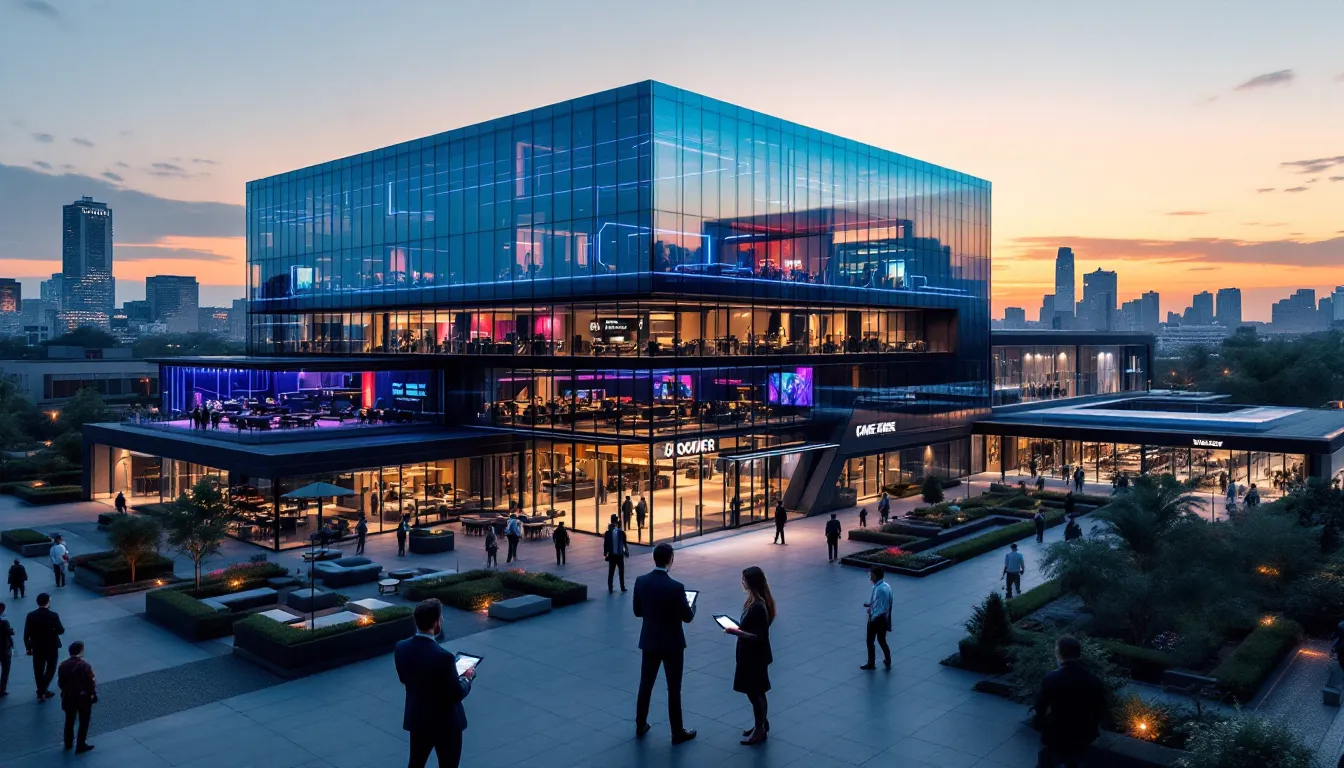

The gaming industry isn’t just growing, it’s rewriting the rulebook for how physical spaces serve communities. What started as cramped arcades stuffed with CRT monitors has exploded into purpose-built esports arenas, VR experience centers, and gaming hotels that rival five-star resorts. These aren’t just buildings: they’re cultural hubs where competitive gamers sharpen their skills, casuals hang out for the vibes, and investors see serious ROI potential.
Gaming and leisure properties represent a booming intersection of real estate development, hospitality, and interactive entertainment. As of 2026, the gaming property sector is pulling in billions annually, driven by the mainstreaming of esports, the rise of social gaming experiences, and Gen Z’s preference for IRL gaming hangouts over traditional entertainment venues. Whether you’re a gamer curious about what makes these spaces tick, an aspiring entrepreneur eyeing the market, or just wondering why there’s suddenly a gaming hotel down the street, this guide breaks down everything you need to know about the properties defining gaming culture today.
Key Takeaways
- Gaming and leisure properties—including esports arenas, VR arcades, gaming cafes, and gaming hotels—have evolved into a multi-billion dollar real estate sector driven by esports professionalization and Gen Z’s preference for in-person gaming experiences.
- Successful gaming and leisure properties diversify revenue through hourly rental fees ($5-15 for cafes, $30-60 for VR), high-margin food and beverage (30-40% of income), sponsorships, and event hosting rather than relying solely on gaming fees.
- Cloud gaming integration and mixed reality technologies will reduce hardware costs by 60-70% and enable new venue experiences, making gaming properties more accessible and profitable for operators through 2030.
- Urban locations near public transit and hotels significantly outperform isolated facilities, with successful arenas maintaining 60%+ utilization by hosting community tournaments, amateur leagues, and non-gaming entertainment between major competitions.
- The fastest-growing segment, location-based VR venues with free-roam experiences and motion platforms, command $30-60 per session with strong repeat customer rates (40-50% return within 90 days) when content refreshes quarterly.
- Gaming property investors should prioritize operational excellence in technology management, genuine community building, and hybrid entertainment models over hype, with institutional investors targeting 12-18% IRR returns and 7-10 year hold periods.
What Are Gaming and Leisure Properties?
Defining the Intersection of Real Estate and Gaming Culture
Gaming and leisure properties are physical real estate developments designed specifically to host, support, or monetize gaming activities. They’re distinct from general entertainment venues because they cater explicitly to gaming communities, whether that’s competitive esports athletes, VR enthusiasts, LAN party regulars, or mobile gamers looking for premium setups.
These properties blend traditional real estate development with gaming infrastructure: high-speed fiber internet, dedicated server rooms, broadcast-ready stages, and custom seating designed for marathon sessions. The key differentiator is intent, every design choice prioritizes the gaming experience, from soundproofing for trash talk to RGB lighting that would make a Razer peripheral blush.
Types of Gaming and Leisure Properties
The gaming property landscape includes several distinct categories, each serving different segments of the gaming community:
- Esports arenas and competition venues: Purpose-built stadiums with broadcast facilities, team practice rooms, and spectator seating.
- Gaming cafes and LAN centers: Social gaming spaces offering high-end PC or console setups on an hourly rental basis.
- VR arcades and immersive experience centers: Venues specializing in virtual reality hardware and location-based VR experiences.
- Gaming hotels and themed accommodations: Lodging facilities featuring in-room gaming setups, tournament viewing areas, and gaming-centric amenities.
- Gaming retail and entertainment complexes: Multi-purpose destinations combining merchandise, play spaces, food and beverage, and community events.
- Streaming studios and content creation hubs: Facilities designed for streamers and content creators, with production equipment and collaborative spaces.
Each property type addresses specific needs within gaming culture, and many developers are blending categories to create hybrid spaces that maximize utilization and revenue potential.
The Evolution of Gaming-Centric Real Estate
From Arcades to Esports Arenas: A Historical Perspective
The lineage of gaming properties traces back to the arcade golden age of the 1980s. Arcades were the first dedicated gaming real estate, loud, neon-lit spaces where quarters ruled and high scores meant bragging rights. These venues peaked in the mid-80s before home consoles gutted the business model.
The LAN cafe boom of the late 90s and early 2000s marked the next evolution, particularly in Asia. South Korea’s PC bang culture proved that gamers would pay hourly rates for superior hardware and social gaming atmospheres. These cafes became cultural fixtures, spawning the infrastructure that would later support professional esports.
The 2010s brought purpose-built esports arenas as competitive gaming went mainstream. Riot Games’ LCS Studio in Los Angeles (opened 2015) and Blizzard Arena (2017-2018) demonstrated that esports could fill dedicated venues. By 2020, cities were competing to build esports stadiums, viewing them as economic drivers similar to traditional sports venues.
Today’s gaming properties represent a maturation of all these concepts, with developers understanding that modern gamers want premium experiences across multiple formats, competitive, social, immersive, and content-driven.
Modern Trends Driving Gaming Property Development
Several converging trends are accelerating gaming property development in 2026:
Esports professionalization: As competitive gaming solidifies its status as legitimate sport, teams and leagues demand proper training facilities and competition venues. The gaming industry’s rapid growth has created demand for specialized infrastructure that mirrors traditional sports.
Social gaming resurgence: Post-pandemic, younger gamers increasingly value IRL gaming experiences over solitary home play. Group gaming sessions, viewing parties, and community events drive foot traffic to physical venues.
Hybrid entertainment models: Developers recognize that pure gaming spaces face utilization challenges. Successful properties integrate food and beverage, retail, concerts, and other revenue streams to maintain profitability across different dayparts.
Technology accessibility: VR hardware costs have dropped significantly, making location-based VR experiences viable for arcade-style businesses. Similarly, cloud gaming reduces hardware investment barriers for property operators.
Real estate investment diversification: Institutional investors view gaming properties as alternative assets with strong demographic tailwinds, particularly as traditional retail and office spaces struggle.
Esports Arenas and Competition Venues
Purpose-Built Esports Stadiums Around the World
Purpose-built esports arenas represent the flagship category of gaming properties, designed to host professional competitions with production values matching traditional sports broadcasts.
Notable venues as of 2026:
- Esports Stadium Arlington (Texas, USA): North America’s largest dedicated esports facility at 100,000+ square feet, hosting major League of Legends, Valorant, and Call of Duty tournaments.
- LGD Gaming Center (Hangzhou, China): Integrated into the Hangzhou Asian Games complex, this facility hosted esports as a medal event and continues as a permanent competition venue.
- Fusion Arena (Philadelphia, USA): 3,500-capacity venue specifically built for Overwatch League and other Comcast Spectacor esports properties, featuring a 60-foot LED wall and team training facilities.
- Allied Esports HyperX Arena (Las Vegas, USA): 30,000-square-foot venue inside the Luxor Hotel & Casino, blending tournament hosting with daily gaming experiences for tourists.
- Excel Esports Centre (London, UK): European facility combining competition stage, streaming studios, and fan experience areas.
These venues typically cost $15-50 million to develop, depending on size and location. The business model relies on tournament hosting fees, sponsorships, ticket sales, and increasingly, non-gaming event rentals (concerts, corporate events) to maintain year-round utilization.
What Makes an Esports Arena Successful
Successful esports arenas balance athlete needs, spectator experience, broadcast requirements, and operational flexibility:
Infrastructure essentials:
- Network architecture: Redundant fiber connections with sub-1ms latency to game servers, isolated networks for competition integrity.
- Broadcast production: Control rooms, commentary booths, camera positions, and lighting designed for multi-platform streaming.
- Flexible staging: Modular setups accommodating different game titles and formats (1v1 fighting games through 5v5 MOBA tournaments).
- Player facilities: Soundproof practice rooms, secure gear storage, dedicated restrooms and green rooms for competitors.
Spectator experience factors:
- Sightlines: Stadium seating optimized for viewing both live gameplay and screen displays simultaneously.
- Audio design: Acoustics that create atmosphere without interfering with player communication or broadcast audio.
- Concessions and amenities: Food options, merchandise shops, and social spaces that keep fans engaged during breaks.
Location matters intensely. Urban venues near public transit and hotels perform better than isolated facilities. According to coverage on gaming technology infrastructure, venues near major airports see 40% more tournament bookings due to team travel logistics.
The most successful arenas maintain 60%+ utilization by hosting community tournaments, amateur leagues, content creator events, and non-gaming entertainment between major professional competitions.
Gaming Cafes and LAN Centers
The Rise of Premium Gaming Lounges
Gaming cafes have evolved significantly from the basic PC bang model. Modern gaming lounges position themselves as premium social destinations, targeting gamers who want better hardware than they own at home or prefer gaming in communal environments.
The 2026 gaming cafe operates on two parallel business models:
Hourly rental model: Traditional approach charging $5-15/hour for access to high-end gaming PCs or console stations. Successful cafes maintain hardware refresh cycles every 18-24 months, ensuring customers always have access to current-gen equipment (RTX 50-series GPUs, latest AMD Ryzen processors, 240Hz+ monitors).
Premium lounge model: Membership-based or higher-priced venues ($20-40/hour) offering luxury seating, dedicated server hosting, food and beverage service at stations, and private party rooms. These target working professionals and competitive teams willing to pay premium rates for superior experiences.
Geographic success patterns:
- Urban markets with high housing costs (where gamers lack space for elaborate setups) show strongest demand.
- College towns support gaming cafes through consistent student traffic.
- Suburban locations struggle unless they differentiate through unique offerings (VR, tournament hosting, creator studios).
Major chains like Wanyoo (China, expanding to US markets), Belong Gaming Arenas (UK, acquired by Game in 2019 and expanding), and Fortress Melbourne (Australia) demonstrate the scalability of professional gaming cafe operations.
Key Features Gamers Expect from Gaming Cafes
Gamers in 2026 have specific expectations based on what premium cafes deliver:
Hardware standards:
- Gaming PCs with current-gen GPUs capable of 240+ FPS in competitive titles
- Mechanical keyboards (Cherry MX or equivalent switches)
- Gaming mice with at least 16,000 DPI sensors
- 240Hz or 360Hz monitors (27″ for most games, 24″ for competitive FPS)
- Quality gaming headsets with noise cancellation
- Ergonomic gaming chairs (DXRacer, Secretlab, or similar)
Software and services:
- Pre-installed library of popular games (Steam, Epic, Battle.net, EA app)
- Active Discord servers for community building
- Tournament hosting and leagues
- Coaching services for competitive improvement
Atmosphere and amenities:
- Low latency fiber internet (minimum 1 Gbps symmetrical)
- RGB lighting that’s aesthetic but not distracting
- Soundproofing between sections for different gaming types
- Full food and beverage menus deliverable to stations
- Streaming setups available for content creators
- Clean, well-maintained facilities (poor maintenance kills gaming cafes faster than any other factor)
Pricing transparency matters, hidden fees for game access, premium titles, or equipment upgrades create friction. Successful cafes bundle everything into simple hourly rates.
VR Arcades and Immersive Experience Centers
How Virtual Reality Is Transforming Leisure Spaces
VR arcades represent the fastest-growing segment of gaming properties, capitalizing on hardware that remains too expensive or space-intensive for most home setups. The business model solves VR’s biggest consumer friction point: the $1,500+ barrier to entry for quality experiences.
Location-based VR (LBVR) offers experiences impossible in home environments:
Free-roam VR: Warehouse-scale play areas (2,000-10,000 sq ft) where players physically walk through virtual environments. Titles like Zero Latency’s multiplayer zombie shooters or Sandbox VR’s licensed experiences (Star Trek: Discovery Away Mission, Deadwood Mansion) require dedicated facilities with motion tracking systems covering entire rooms.
Motion platform VR: Flight simulators, racing rigs, and motion seats synchronized with VR headsets. These combine VR immersion with physical motion that home users can’t replicate.
Social VR experiences: Multi-player adventure games designed for groups (parties, corporate team building, dates). The social component drives repeat visits more effectively than solo experiences.
Technical advantages of LBVR venues:
- Professional-grade headsets (Varjo XR-4, HTC Vive Focus Vision, Meta Quest Pro) refreshed regularly
- Dedicated PCs with RTX 4090 or better GPUs for maximum visual fidelity
- Industrial-grade tracking systems exceeding consumer lighthouse setups
- On-site technical support resolving issues immediately
- Sanitization and hygiene protocols (critical for face-worn hardware)
Revenue models typically charge $30-60 per person for 45-60 minute sessions. Major markets show strong repeat customer rates (40-50% of customers return within 90 days) when content libraries refresh quarterly.
Popular VR Gaming Destinations
The VR arcade market has consolidated around several successful chains and notable independents:
Major VR arcade operators:
- Sandbox VR: 30+ locations globally (US, Hong Kong, Singapore), focusing on premium Hollywood-licensed content with haptic vests and full-body tracking.
- Zero Latency: 70+ venues across 25 countries, specializing in free-roam multiplayer shooter experiences.
- Hologate: 500+ installations worldwide using smaller footprints (4-8 player pods) suitable for placement within existing entertainment venues.
- The VOID: Pioneer of hyper-reality experiences combining VR with physical sets (now operating under Hyper-Reality Partners after restructuring).
Standalone destination venues:
- Area 15 (Las Vegas): Immersive entertainment district featuring multiple VR experiences alongside other attractions.
- Dreamscape Immersive: Former mall-based VR operator that pivoted to larger-format location-based entertainment.
- Two Bit Circus (Los Angeles): Micro-amusement park blending VR, AR, projection mapping, and traditional carnival games.
Successful VR venues share common traits: locations in high foot-traffic entertainment districts, partnerships with shopping malls or entertainment complexes, and content refresh cycles every 3-6 months to encourage repeat visits. The evolving landscape of gaming entertainment continues reshaping how these venues operate and monetize experiences.
Gaming Hotels and Themed Accommodations
What Sets Gaming Hotels Apart from Traditional Lodging
Gaming hotels transform lodging from a place to sleep into a destination experience for gaming enthusiasts. These properties cater to travelers attending esports events, gaming tourists, and gamers seeking premium staycation experiences.
Core differentiators from traditional hotels:
In-room gaming setups: Dedicated gaming stations with high-end PCs or current-gen consoles (PS5, Xbox Series X), gaming monitors (144Hz minimum), and quality peripherals. Some properties allow guests to choose their platform during booking.
Network infrastructure: Enterprise-grade internet with guaranteed bandwidth per room (100-300 Mbps minimum), optimized routing to game servers, and redundancy eliminating downtime.
Gaming-centric amenities:
- Tournament viewing lounges with stadium seating and large-format displays
- LAN party rooms bookable for groups
- Retro gaming arcades featuring classic cabinets
- Streaming studios available for content creator guests
- 24/7 concierge services familiar with gaming (can recommend local gaming venues, arrange tournament tickets, troubleshoot tech issues)
Themed design: Room décor incorporating gaming aesthetics without being juvenile, think sophisticated RGB accent lighting, game-inspired art, and ergonomic gaming furniture rather than cartoon characters.
Food and beverage: Room service and on-site restaurants with gaming session-friendly options (one-handed snacks, energy drinks, meal timing accommodating raid schedules).
Notable Gaming-Themed Hotels and Resorts
Gaming hotels have evolved from novelty concepts to legitimate hospitality segments:
Atari Hotels: First location opened in Las Vegas (2024), with additional properties in development. Features include dedicated esports arenas, retro and modern gaming throughout, themed suites (Pong, Centipede), and partnerships with gaming brands for tournaments and events.
Luxor Hotel & Casino (Las Vegas): While not exclusively gaming-focused, houses HyperX Esports Arena and offers gaming-enhanced rooms with pre-installed consoles and high-speed internet.
The Gaming Stadium Hotel (Taipei, Taiwan): Purpose-built property with 50 gaming-themed rooms, each featuring dual gaming setups (PC and console), tournament-viewing facilities, and partnerships with Taiwanese esports organizations.
Hotel RL by Red Lion (Washington State): Multiple locations offering “Gamer Rooms” with Xbox or PlayStation consoles, gaming chairs, and streaming capabilities at modest price premiums over standard rooms.
esports Stadium Arlington Hotel (proposed): Plans for adjacent hotel property specifically serving Arlington’s esports venue, with team housing, broadcast facilities, and fan accommodations.
Business model considerations:
Gaming hotels typically command 15-30% room rate premiums over comparable non-gaming properties in the same market. Revenue comes from room rates, tournament hosting, esports team training camps, content creator partnerships (sponsored stays in exchange for promotion), and food and beverage.
Location near major esports venues or gaming conventions (PAX, E3, TwitchCon, regional championships) drives occupancy during event weekends. Successful properties maintain 65%+ occupancy through gaming-tourist traffic during non-event periods.
Gaming Retail and Entertainment Complexes
Multi-Purpose Gaming Destinations
Gaming retail and entertainment complexes represent the most ambitious category of gaming properties, large-format destinations combining multiple gaming experiences, retail, dining, and community spaces under one roof.
These properties solve the utilization problem plaguing single-purpose gaming venues by offering complementary attractions that drive traffic across different times and customer segments:
Typical complex components:
- Retail anchor: Gaming merchandise, hardware, peripherals, collectibles, and apparel from major publishers and third-party brands.
- Experience zones: Playable demo stations for upcoming releases, VR experiences, tournament viewing areas.
- Food hall or restaurants: Multiple dining concepts ranging from quick-service to sit-down restaurants with gaming themes.
- Competition arena: Smaller stage for local tournaments, community events, and content creation.
- Social gaming areas: Casual play spaces with consoles, board game libraries, or retro gaming.
- Creator studios: Rentable spaces for streamers and content creators with production equipment.
Operating models:
Some complexes operate as integrated destinations under single ownership, while others function as curated collections of independent operators (similar to food halls). The latter reduces capital requirements but requires strong property management to maintain cohesive experiences.
Examples of gaming complexes:
- Super League Gaming venues: Nationwide chain (primarily US) operating gaming centers within movie theaters and retail spaces, hosting amateur leagues and casual play.
- LG UltraGear Gaming Zone: Pop-up and permanent installations showcasing LG gaming hardware through playable experiences.
- Microsoft Experience Centers: Retail locations with dedicated Xbox gaming sections, tournament hosting capabilities, and integration with Microsoft retail.
Real estate dynamics:
Gaming complexes increasingly occupy former big-box retail spaces (dead department stores, abandoned electronics retailers) in malls seeking new anchor tenants. This creates symbiotic relationships, malls get foot traffic generators, gaming operators get affordable large-format spaces in high-traffic locations.
The Role of Merchandise and Community Spaces
Retail and community spaces serve critical functions beyond direct revenue:
Merchandise drives brand affinity: Gaming retail isn’t just about selling products, it’s about creating brand moments. Limited edition drops, exclusive collectibles, and meet-and-greets with streamers or pro players turn shopping into experiences. Successful gaming retailers understand they’re competing with online shopping, so they emphasize products that benefit from physical inspection (peripherals where feel matters, apparel for fit and quality assessment, collectibles where authenticity concerns drive in-person purchases).
Community spaces build loyalty: Dedicated areas for meetups, viewing parties, and hangouts create reasons for regular visits beyond transactions. Retailers partnering with major gaming companies often host community events that strengthen local gaming ecosystems.
Benefits of integrated community areas:
- Regularized traffic: Weekly game nights, launch parties, and local tournaments create predictable visitor patterns.
- User-generated content: Community events generate social media content and word-of-mouth marketing.
- Market research: Direct customer feedback on products and gaming trends.
- Extended dwell time: Customers spending more time on property increases F&B sales and impulse merchandise purchases.
The most successful gaming complexes treat community programming as core business rather than marketing expense, allocating 20-30% of floor space to non-revenue community areas that drive indirect monetization.
The Business Behind Gaming Properties
Revenue Streams and Investment Opportunities
Gaming properties operate on diverse revenue models that blend real estate, entertainment, and hospitality income streams:
Primary revenue sources:
Rental and admission fees: Core income from hourly PC/console rentals ($5-15/hour), VR session fees ($30-60/session), venue rental for tournaments and private events ($500-5,000+ depending on size and duration).
Food and beverage: Often the highest-margin revenue stream. Successful gaming properties maintain F&B revenue at 30-40% of total income. Captive audiences during gaming sessions and events drive strong per-customer spending.
Sponsorships and partnerships: Gaming peripheral brands (Razer, Logitech, Corsair), energy drink companies (Red Bull, G Fuel, Monster), and game publishers pay for branding, product placement, and exclusive partnership rights. Major venues secure $100K-$1M+ annually in sponsorship revenue.
Tournament and event hosting: Fees from tournament organizers, ticket sales, broadcast rights, and merchandise sales during competitions.
Memberships and subscriptions: Recurring revenue from monthly or annual memberships offering discounted rates, priority booking, and exclusive access to events.
Content licensing and media: Some properties monetize through content creation, streaming tournaments, producing gaming shows, or licensing their brand to media projects.
Retail and merchandise: For properties with retail components, product sales provide both revenue and marketing (customers wearing venue-branded apparel serve as walking advertisements).
Investment landscape:
Gaming properties have attracted institutional investment as alternative real estate assets. REIT-style vehicles focused on esports and gaming properties emerged in 2023-2024. Typical returns target 12-18% IRR with 7-10 year hold periods.
Investment capital sources include:
- Traditional real estate developers diversifying portfolios
- Gaming and esports companies (publishers, teams, leagues) vertically integrating into venue ownership
- Private equity funds focused on experiential entertainment
- Family offices and high-net-worth individuals (often gamers themselves) making passion investments
Development costs vary widely: gaming cafes ($200K-$800K), VR arcades ($500K-$2M), esports arenas ($15M-$50M+), gaming hotels (dependent on property size, typically $150-300 per sq ft for gaming-specific infrastructure and theming).
Challenges Facing Gaming Property Developers
Gaming properties face unique obstacles distinct from traditional real estate development:
Rapid technology obsolescence: Gaming hardware requires continuous capital investment. PC gaming cafes face GPU refresh cycles every 18-24 months to maintain competitive positioning. VR arcades must update headsets as new generations release. This creates ongoing CapEx requirements rarely seen in traditional real estate.
Utilization and scheduling: Pure gaming venues face weekday utilization challenges. Properties may hit 80-90% capacity Friday-Sunday but drop to 20-30% Monday-Thursday. Successful operators diversify with corporate events, school programs, senior gaming sessions, and non-gaming entertainment to smooth revenue.
Gaming meta and trend sensitivity: Properties too closely tied to specific game titles risk abandonment when those games lose popularity. Overwatch League venues faced challenges when player interest declined. Diversified facilities supporting multiple game titles and genres show better resilience.
Local market expertise required: Gaming culture varies significantly by region. Asian markets support different business models (PC bang hourly rates, mobile gaming cafes) than Western markets. Developers lacking local gaming community knowledge frequently overinvest in wrong formats.
Licensing and rights complexity: Gaming properties must navigate complex licensing requirements for commercial game usage, tournament broadcasting rights, and music licensing (in-game soundtracks played in public spaces).
Competition from home gaming: As consumer hardware improves and becomes more affordable, gaming properties must continuously justify why customers should leave home. The value proposition must center on social experience, superior hardware, or unique offerings (VR, tournaments, community) rather than just access to games.
Regulatory uncertainty: Some jurisdictions treat gaming cafes as internet cafes (with restrictive regulations), others as entertainment venues, and some as potential gambling establishments. Regulatory classification significantly impacts operational requirements and feasibility.
The Future of Gaming and Leisure Real Estate
Emerging Technologies Shaping Next-Gen Gaming Venues
Several technologies will fundamentally reshape gaming properties over the next 3-5 years:
Cloud gaming integration: As services like Xbox Cloud Gaming, GeForce Now, and Amazon Luna mature, gaming cafes can reduce hardware costs while offering broader game libraries. Venues could shift from maintaining expensive gaming PCs to providing premium peripherals and displays connected to cloud infrastructure. This dramatically changes the economics, reducing CapEx by 60-70% while lowering the barrier to entry for new operators.
AI-powered personalization: Properties are implementing AI systems that remember customer preferences, automatically configure game settings, adjust lighting and temperature based on gaming session types, and recommend games based on play history. Some experimental venues use AI to dynamically price hourly rates based on demand, similar to ride-sharing surge pricing.
Mixed reality (MR) experiences: Apple Vision Pro and Meta Quest 3’s mixed reality capabilities enable new hybrid experiences blending physical venue spaces with digital overlays. Imagine laser tag where virtual monsters populate real warehouse spaces, or strategy games where tabletop surfaces become battlefields. These experiences require dedicated facilities designed for mixed reality gameplay.
Biometric integration: Advanced venues are testing biometric systems tracking player stress, engagement, and fatigue. This data could optimize tournament scheduling, help players understand performance patterns, and enable new spectator experiences (live heart rate displays during clutch moments).
5G and edge computing: Ultra-low latency networks enable new categories of location-based gaming impossible with current infrastructure. Reports from technology publications tracking gaming infrastructure suggest that edge computing deployments will reduce cloud gaming latency to sub-10ms by 2027, making cloud gaming viable for competitive play.
Blockchain and digital ownership: Some properties experiment with NFT-based membership systems, digital collectibles tied to physical venues, and blockchain-verified tournament results and leaderboards. Adoption remains niche in 2026 but growing.
Sustainable gaming venues: Energy costs for gaming properties (particularly those running hundreds of gaming PCs) drive interest in solar installation, efficient cooling systems, and lower-power hardware. Some European venues have achieved carbon-neutral operations through renewable energy and hardware efficiency programs.
Predictions for Gaming Properties Through 2030
Several trends will define gaming property development through the end of the decade:
Consolidation and franchising: The current fragmented market of independent operators will consolidate. Expect 3-5 major chains to dominate gaming cafes and VR arcades by 2030, with franchise models enabling rapid expansion while maintaining quality standards.
Hybrid entertainment models become standard: Pure gaming venues will become rare. Successful properties will blend gaming with F&B, fitness (VR fitness gaining traction), creative spaces (music production, 3D modeling), and traditional entertainment. The line between gaming venue and general entertainment complex will blur.
Suburban expansion: As remote work persists, gaming properties will follow population shifts to suburbs and secondary cities. Urban flagship locations will focus on premium experiences and tournaments, while suburban outlets emphasize convenience and community.
Educational integration: Gaming properties partnering with educational institutions to offer esports programs, game development courses, and STEM education through gaming. Some high schools and universities will operate on-campus gaming facilities rivaling commercial venues.
Wellness focus: Gaming venues addressing health concerns through ergonomics, eye care (blue light management), nutrition programs, and fitness integration (VR exercise experiences). Properties marketing themselves as healthy gaming environments will differentiate against the “gamer in basement” stereotype.
Regional supercluster development: Major metropolitan areas will develop “gaming districts” with clusters of complementary properties, esports arena, gaming hotels, retail complexes, and content creator studios within walking distance. Las Vegas, Los Angeles, Seoul, Tokyo, and Shanghai are leading this trend.
Valuation growth: As the gaming property asset class matures, expect institutional investment to drive property valuations upward. Prime gaming real estate in major markets will command premiums similar to Class A retail or entertainment venues.
The gaming property sector is entering its growth phase. Early movers establishing strong brands, operational excellence, and community ties will dominate as the market expands through the late 2020s.
Conclusion
Gaming and leisure properties have evolved from niche novelties into a legitimate real estate sector serving the world’s fastest-growing entertainment industry. These spaces, whether esports arenas hosting thousand-person tournaments, VR arcades delivering experiences impossible at home, gaming cafes serving as community hubs, or hotels catering to gaming tourists, represent the physical manifestation of gaming culture’s mainstream arrival.
The sector’s growth trajectory through 2030 looks strong, driven by esports professionalization, social gaming’s resurgence, and generational preferences favoring experiential entertainment. Successful properties will be those that solve real problems for gaming communities: offering hardware most can’t afford at home, creating spaces for IRL connections, hosting competitive opportunities, and building genuine communities rather than just renting equipment.
For investors, developers, and entrepreneurs eyeing this space, the fundamentals matter more than hype: understand your local gaming community, build operational excellence around technology management and customer service, diversify revenue streams beyond pure gaming, and maintain the agility to adapt as gaming technology and culture evolve. Gaming properties that nail these fundamentals while delivering authentic experiences will thrive as gaming continues reshaping how people play, connect, and spend their leisure time.