
Boyd Gaming’s logo isn’t just corporate branding, it’s a symbol that’s been part of the casino and gaming landscape for five decades. While most gamers know the flashy brands like MGM and Caesars, Boyd Gaming operates 28 properties across 10 states, quietly building one of the most recognizable marks in the casino industry. But here’s where it gets interesting for the gaming community: Boyd Gaming has expanded beyond slot machines and poker tables into partnerships with digital gaming platforms, esports sponsorships, and even mobile gaming apps. Their visual identity matters because it bridges traditional casino culture with the evolving world of competitive gaming and digital entertainment. If you’ve ever wondered about the design thinking behind major gaming brands, or you’re tracking how casino companies are integrating with video game culture in 2026, the Boyd Gaming logo tells a surprisingly layered story.
Key Takeaways
- Boyd Gaming’s logo evolved from bold 1970s Vegas aesthetics to a clean, digital-first design that bridges traditional casino operations with modern gaming culture.
- The navy blue and cardinal red color scheme strategically signals trustworthiness and excitement, making the Boyd Gaming logo effective across physical casino properties and mobile gaming platforms.
- Unlike competitors MGM and Caesars, Boyd Gaming prioritizes minimal, functional branding over decorative iconography, allowing the logo to scale seamlessly from 50-foot casino marquees to 60×60 pixel app icons.
- Boyd Gaming’s esports sponsorships and skill-based gaming partnerships since 2018 have positioned the brand as a bridge between regional gaming communities and next-generation digital entertainment.
- Strict brand standards governing minimum size (0.25 inches in print), clear space requirements, and approved color variations ensure consistent Boyd Gaming logo reproduction across 28 properties in 10 states.
- Future logo evolution will likely incorporate AR/VR adaptations, animated micro-interactions for mobile apps, and enhanced accessibility features as casino gaming integrates with emerging technologies.
What Is Boyd Gaming and Why Does Their Logo Matter?
Boyd Gaming Corporation is a multi-billion dollar gaming and hospitality company founded by Sam Boyd in 1975. The company operates casino resorts primarily in Nevada and the Midwest, with flagship properties including The Orleans, Gold Coast, and Sam’s Town casinos in Las Vegas.
Their logo matters in the gaming world for three key reasons. First, it represents one of the oldest continuously operating casino gaming companies in the United States, giving it historical weight in an industry where brands rise and fall with brutal frequency. Second, Boyd Gaming has been an early adopter of cross-platform gaming initiatives, partnering with digital gaming providers to offer skill-based gaming experiences and mobile platforms, making their brand relevant to younger, digitally-native gamers. Third, their sponsorship deals with esports teams and gaming events since 2019 have pushed their visual identity into spaces where traditional casino brands rarely venture.
The logo itself functions as shorthand for a specific approach to gaming: local-focused rather than strip-centric, player-centric loyalty programs, and increasingly, a bridge between physical and digital gaming experiences. In 2026, as casino operators compete for the attention of Gen Z and millennial gamers who grew up on console and PC gaming, Boyd Gaming’s brand evolution offers a case study in how traditional gaming companies adapt their visual identity to stay relevant.
The Complete History of the Boyd Gaming Logo
Original Logo Design (1975-1990s)
Boyd Gaming’s original logo was unapologetically retro, think bold serif typefaces and the kind of visual design that screamed 1970s Vegas excess. The earliest iterations featured thick, condensed lettering with heavy stroke weight, often rendered in gold or bronze tones to evoke luxury and winning.
The design philosophy was straightforward: visibility from a distance (critical for casino signage) and instant association with gambling’s golden age. During this period, the logo appeared primarily on physical casino properties, promotional materials, and the limited direct mail campaigns that drove player traffic in the pre-internet era.
Color palettes leaned heavily into warm metallics, gold, brass, and copper, paired with deep burgundy or forest green. This wasn’t accidental. Casino design psychology in the ’70s and ’80s relied on colors associated with wealth, comfort, and the kind of nostalgic Americana that drew both locals and tourists.
The logo rarely appeared in standardized formats during this era. Each casino property under the Boyd umbrella often had semi-independent branding, with the parent company logo functioning more as a corporate marker than a consumer-facing brand. You’d see it on stock reports and industry trade shows, but not plastered across every touchpoint the way modern brand standards demand.
Modern Logo Evolution (2000s-Present)
The shift to the current Boyd Gaming logo happened gradually through the 2000s as the company consolidated its brand identity. The modern version features a cleaner, sans-serif wordmark with significantly improved legibility across digital platforms, a necessity as online gaming and mobile apps became core to casino operations.
Key changes include:
- Simplified letterforms with uniform stroke weight
- Transition from metallic gradients to flat, bold colors (primarily deep blue and red)
- Introduction of a subtle geometric element in some variants (though the wordmark-only version remains most common)
- Standardized spacing and proportion for consistent reproduction across screen sizes
The 2010s saw Boyd Gaming invest heavily in brand consistency, rolling out comprehensive guidelines that governed logo usage across all 28 properties. This coincided with their expansion into social casino gaming and partnerships with real-money gaming platforms in states where online gambling was legalized.
By 2020, the logo had fully transitioned to a digital-first design philosophy. The current version (as of 2026) prioritizes scalability, it needs to work equally well on a 50-foot casino marquee, a mobile app icon at 60×60 pixels, and an esports jersey patch. The color palette has been optimized for both print (CMYK) and digital (RGB/HEX) reproduction, with specific variants for dark mode interfaces on gaming apps.
Breaking Down the Boyd Gaming Logo Design Elements
Color Palette and Brand Psychology
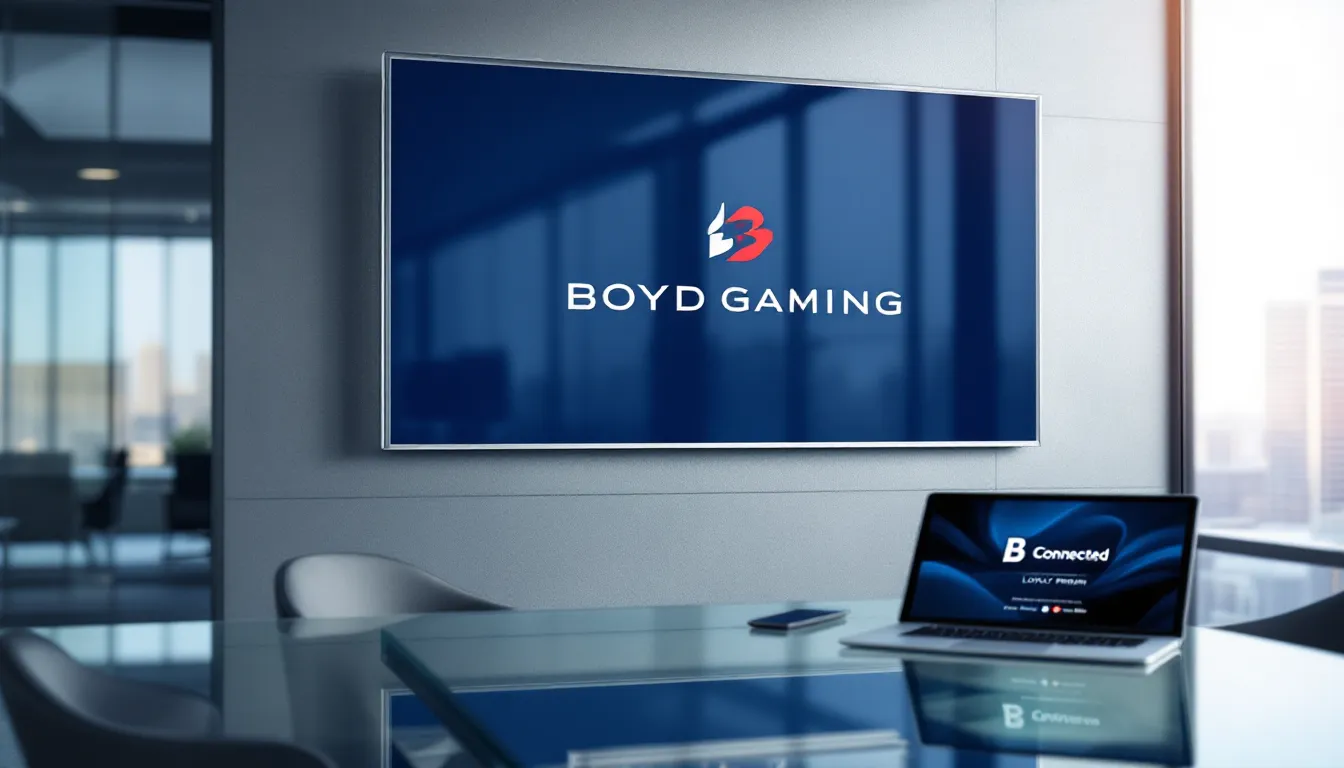
The primary Boyd Gaming color scheme uses navy blue (#002855) and cardinal red (#C8102E) as its core colors. This isn’t random, both colors carry specific psychological weight in gaming environments.
Navy blue signals trustworthiness, stability, and corporate authority. For a casino brand, this matters immensely. Gamers need to believe their money is safe, payouts are legitimate, and the operation is above-board. Blue is the go-to color for financial institutions for exactly this reason, and Boyd Gaming leverages that same psychological association.
The red accent serves a different function. Red increases heart rate, creates urgency, and grabs attention, useful for CTAs (call-to-action elements) on gaming apps and promotional materials. In casino floor design, red is used strategically to stimulate action and excitement without overwhelming the space.
Secondary colors include neutral grays and off-whites for backgrounds and supporting text. The company avoids the garish neon palettes common to older casino branding, opting instead for a corporate-clean look that translates better to digital platforms and appeals to younger demographics.
Typography and Font Choices
The current Boyd Gaming wordmark uses a custom sans-serif typeface with several distinct characteristics:
- High x-height (the height of lowercase letters relative to capitals) for improved readability at small sizes
- Generous letter spacing that prevents visual crowding on mobile screens
- Geometric construction with minimal variation in stroke width
- Slightly condensed proportions to maximize horizontal space efficiency
The font choice reflects a broader industry trend away from decorative, personality-driven typefaces toward functional, neutral designs that work across contexts. This is the same logic driving tech company rebrandings, think Google’s shift from serif to sans-serif in 2015.
For body copy and supporting materials, Boyd Gaming typically uses system fonts like Helvetica Neue or Arial on digital platforms, and corporate standards like Gotham or Proxima Nova in print. The priority is consistency and accessibility rather than typographic flair.
Symbolism and Visual Messaging
Unlike some casino brands that incorporate playing cards, dice, or explicitly gambling-related imagery, the Boyd Gaming logo is almost aggressively minimal. The wordmark stands alone, with no additional iconography in most applications.
This design choice sends a specific message: we’re a corporation first, a casino operator second. It positions Boyd Gaming as a serious business entity rather than a flashy entertainment brand. This matters for investor relations, regulatory compliance, and partnerships with mainstream brands that might be squeamish about overt gambling associations.
When the logo does appear with supporting graphics, it’s typically paired with architectural photography of their casino properties or abstract geometric patterns. These visuals emphasize physical presence and scale rather than the chaos and chance traditionally associated with gambling.
The absence of symbolism is itself symbolic. Many gaming communities have picked up on how Boyd Gaming’s branding parallels the design philosophy of platforms like How-To Geek, where clean, functional design takes precedence over decorative elements.
How Boyd Gaming’s Branding Influences Casino Gaming Culture
The Logo’s Presence in Video Game Partnerships
Boyd Gaming has quietly integrated its branding into several video game partnerships since 2018, though these collaborations fly under the radar compared to flashier brand deals in the gaming space.
The company partnered with GameCo (a skill-based gaming machine manufacturer) to install video game-style gambling terminals in select properties. These machines feature competitive gameplay elements, think fighting game mechanics or racing challenges, where player skill influences payout probability. The Boyd Gaming logo appears on machine casings and in-game UI, creating brand association with a younger demographic that grew up on console gaming.
In 2021, Boyd Gaming signed a deal with DraftKings to offer sports betting and online casino gaming in states with legalized frameworks. The co-branded experience features both logos, with Boyd Gaming lending regulatory credibility and physical infrastructure while DraftKings provides the tech platform. For gamers who engage with sports betting as part of their esports viewing experience, this partnership made Boyd Gaming’s visual identity part of their regular digital routine.
More recently, the company has explored metaverse presence through limited virtual casino experiences. While these initiatives are still experimental as of 2026, they represent an attempt to plant the Boyd Gaming brand in spaces where Gen Z and Gen Alpha gamers already spend time.
Brand Recognition in Gaming and Esports Sponsorships
Boyd Gaming entered esports sponsorship in 2019 with a deal supporting the Allied Esports Arena at the Luxor Hotel (owned by MGM, but hosting multi-brand events). Their logo appeared on event signage and broadcast overlays during tournament streams, introducing the brand to competitive gaming audiences.
The sponsorship strategy focuses on regional and local esports teams rather than top-tier global organizations. This aligns with Boyd Gaming’s overall business model, they’re not trying to compete with MGM or Caesars for the Fortnite World Cup: instead, they sponsor Midwest collegiate esports leagues and state-level tournaments.
Key sponsorship activations include:
- Sam’s Town Hotel & Gambling Hall hosting monthly Super Smash Bros. Ultimate and Street Fighter 6 tournaments with cash prizes
- B Connected Rewards (Boyd Gaming’s loyalty program) offering bonus points for participation in partnered gaming events
- Co-branded streaming content with local influencers in markets where Boyd Gaming operates properties
The effectiveness is debatable. Boyd Gaming’s brand recognition among core esports fans remains low compared to endemic gaming brands, but that’s not necessarily the goal. The strategy seems designed to create ambient awareness among local gaming communities who might translate into casino customers over time.
Industry coverage from outlets like NME Gaming has noted that traditional casino operators face an uphill battle connecting with younger gamers, who often view gambling as predatory or simply irrelevant to their interests.
Boyd Gaming Logo Usage Guidelines and Brand Standards
Boyd Gaming maintains strict brand standards documented in their corporate identity guidelines, though these aren’t publicly available in full. Based on observed usage across official channels, the core rules are:
Minimum size requirements: The logo must maintain a minimum height of 0.25 inches in print or 24 pixels in digital applications to preserve legibility. Below these thresholds, letterforms become indistinct and brand recognition suffers.
Clear space: The logo requires protective clear space equal to the height of the letter ‘B’ on all sides. No other graphic elements, text, or competing logos can intrude into this zone. This prevents visual clutter and ensures the brand mark remains distinct.
Color variations: Three approved versions exist, full color (navy and red), single-color navy, and single-color white (for dark backgrounds). The logo should never appear in unauthorized colors, gradients, or effects like drop shadows or embossing.
Prohibited uses include:
- Stretching, compressing, or distorting proportions
- Rotating or tilting the logo
- Placing on busy photographic backgrounds without sufficient contrast
- Recreating or retyping the wordmark using similar fonts
- Using outdated logo versions from previous brand eras
Co-branding specifications govern how the Boyd Gaming logo appears alongside partner brands. In most partnerships, Boyd Gaming requires equal or greater prominence compared to partner logos, with specific spacing rules to maintain brand hierarchy.
For third-party use (media coverage, industry reports, academic research), Boyd Gaming provides approved logo files in vector (SVG, EPS) and raster (PNG, JPG) formats through their press resources page. Unauthorized reproduction or modification can trigger trademark enforcement.
The standards reflect industry-standard best practices, nothing revolutionary, but executed with the kind of corporate rigor you’d expect from a publicly traded company with billions in annual revenue.
Where You’ll See the Boyd Gaming Logo Today
Physical Casino Properties and Signage
The most prominent Boyd Gaming logo placements are the massive illuminated signs at their 28 casino properties across Nevada, Illinois, Indiana, Iowa, Kansas, Louisiana, Mississippi, Missouri, and Pennsylvania.
Signage strategy varies by property age. Newer constructions like the Sky River Casino (opened 2024 in California) feature LED-backlit logos with programmable lighting that can shift between brand colors and seasonal themes. Older properties like the Fremont Hotel & Casino in downtown Las Vegas retain vintage-style neon signage, though these have been updated to include modern logo variants.
Inside the casinos, the logo appears on:
- Slot machine toppers and cabinet wraps (though these often feature game-specific branding)
- Players club kiosks for the B Connected loyalty program
- Carpeting and wall graphics in high-traffic areas
- Staff uniforms (embroidered on shirts, jackets, and name tags)
- Gaming chips and playing cards at table games
- Restaurant and retail signage for property-specific dining concepts
The physical presence is comprehensive but not overwhelming. Boyd Gaming properties tend toward understated elegance compared to the sensory overload of strip mega-resorts.
Digital Platforms and Mobile Gaming Apps
Boyd Gaming’s digital footprint has expanded significantly since 2020, making logo placement across apps and websites increasingly important.
The B Connected app (available on iOS and Android) features the logo prominently in the app icon and header navigation. The app allows players to track rewards points, book hotel rooms, make dining reservations, and in some states, access real-money online casino games and sports betting.
App Store presence includes:
- Icon design: Simplified ‘B’ monogram in brand colors optimized for recognition at small sizes
- Splash screens: Full logo with animated reveal on app launch
- In-app branding: Persistent header logo with reduced opacity during gameplay to minimize distraction
The company’s website (boydgaming.com) uses a sticky header design that keeps the logo visible during scrolling, a standard UX practice for maintaining brand awareness during extended browsing sessions.
Social media presence across Facebook, Instagram, Twitter/X, and TikTok maintains consistent profile imagery with the logo featured in profile pictures and cover images. Content posts rarely include logo watermarks, instead relying on account association for brand attribution.
Partnership with online gaming platforms means the logo also appears within third-party apps and websites where Boyd Gaming provides operational licensing or regulatory infrastructure.
Comparing Boyd Gaming’s Logo to Other Major Gaming Brands
MGM Resorts vs. Boyd Gaming
MGM Resorts operates with a completely different brand philosophy. Their logo features the iconic roaring lion (derived from the Metro-Goldwyn-Mayer film studio heritage) paired with gold metallic typography. It’s instantly recognizable, rich with Hollywood associations, and screams premium entertainment.
Boyd Gaming’s approach is the polar opposite, minimal, corporate, functional. Where MGM leverages nostalgic iconography and luxury positioning, Boyd Gaming presents as a serious business operator. This makes sense given their respective market positions: MGM targets international tourists and high rollers on the Las Vegas Strip: Boyd Gaming focuses on local and regional players.
Visual complexity: MGM’s logo requires more screen real estate and doesn’t scale down as effectively as Boyd Gaming’s text-only mark. On mobile interfaces, this becomes a practical disadvantage.
Color psychology: MGM’s gold-and-black palette emphasizes exclusivity and prestige. Boyd Gaming’s navy-and-red combination feels more accessible and trustworthy, more ‘your neighborhood casino’ than ‘once-in-a-lifetime Vegas experience.’
Recognition factor: Among casual observers and international audiences, MGM’s lion logo has significantly higher unaided brand recall. Among regional markets where Boyd Gaming operates properties, their logo carries stronger local recognition and loyalty.
Caesars Entertainment vs. Boyd Gaming
Caesars Entertainment takes yet another approach with its Roman-inspired branding. The logo features the Caesars wordmark with a distinctive laurel wreath crown motif, immediately evoking ancient Rome and imperial luxury.
The design is more ornate than Boyd Gaming’s minimalist mark but less icon-dependent than MGM’s lion. Caesars splits the difference, recognizable iconography (the laurel crown) paired with a clear wordmark.
Thematic branding: Caesars commits fully to the Roman theme across properties, marketing, and visual design. Boyd Gaming avoids thematic constraints, allowing individual properties to develop their own identity while maintaining corporate brand standards.
Digital adaptation: Both brands have updated their logos for digital-first usage, but Caesars retains more decorative elements that can create reproduction challenges at very small sizes. Boyd Gaming’s stripped-down approach offers more flexibility.
Target demographic: Caesars positions itself slightly above Boyd Gaming on the prestige spectrum, not as elite as MGM, but more upscale than the value-focused Boyd properties. The logos reflect this positioning: Caesars’ ornamental mark suggests indulgence and spectacle: Boyd Gaming’s clean design suggests reliability and straightforward value.
Reflecting on these comparisons provides insight into how casino brands use visual identity to stake out specific positions in a crowded market. Coverage from annual events like The Game Awards shows how video game brands similarly use logo design to signal their market position, from Nintendo’s playful, family-friendly aesthetic to FromSoftware’s dark, gothic presentation.
The Future of Boyd Gaming’s Visual Identity
Looking ahead to the next evolution of the Boyd Gaming logo, several industry trends and technological shifts will likely influence design decisions.
AR and VR integration will require logo adaptations for spatial computing interfaces. As casino gaming explores virtual reality experiences (skill-based VR slots, virtual poker rooms, social casino environments), brand identities need to work in three-dimensional space. This might push Boyd Gaming toward developing a 3D logo variant or companion brand marks optimized for immersive displays.
Dynamic logos represent another frontier. Major brands like Google and Spotify have experimented with animated, context-responsive logos that change based on user behavior, time of day, or seasonal events. Boyd Gaming could develop animated micro-interactions, subtle logo animations when users complete actions in their mobile app or achieve loyalty program milestones.
Accessibility considerations will become increasingly important. Current web accessibility standards (WCAG 2.1 and the upcoming 3.0 guidelines) require sufficient color contrast ratios, compatibility with screen readers, and adaptations for users with visual impairments. Boyd Gaming’s simple, high-contrast design already meets these requirements, but future iterations might incorporate haptic feedback elements for touchscreen interactions or audio branding components that work alongside the visual mark.
Web3 and blockchain gaming present both opportunities and risks. If casino gaming moves toward cryptocurrency integration and blockchain-verified fairness systems, Boyd Gaming’s brand will need to signal technological sophistication while maintaining regulatory credibility. This might not change the logo itself, but could influence surrounding brand elements and the contexts where the logo appears.
Generational preferences will continue shifting. Gen Z and Gen Alpha show strong preferences for authentic, purpose-driven brands with clear values. Boyd Gaming’s current logo is neutral enough to adapt to various messaging strategies, but future brand evolution might incorporate sustainability messaging or community impact elements that go beyond pure visual design.
Regulatory expansion as more states legalize online gambling and sports betting will require the logo to work in new contexts and alongside new partner brands. The design needs to remain flexible enough to co-exist with state lottery logos, tribal gaming brands, and technology platform partners.
The most likely scenario for the next 3-5 years: Boyd Gaming maintains the core logo design while developing a comprehensive motion design system for digital applications, expanded accessibility features for inclusive gaming experiences, and platform-specific variants optimized for emerging technologies. Wholesale logo redesign seems unlikely given the equity built in the current mark, but expect evolutionary refinements rather than revolutionary change.
Conclusion
The Boyd Gaming logo represents five decades of evolution in casino branding, from flashy ’70s excess to streamlined corporate minimalism. What makes it relevant to the gaming community isn’t its visual flash (there isn’t much), but what it represents: the convergence of traditional gambling and modern gaming culture. As casino operators chase younger demographics through esports sponsorships, skill-based gaming machines, and digital platforms, their visual identities become bridges between old-school Vegas and the Fortnite generation.
Boyd Gaming’s design strategy prioritizes function over flair, accessibility over ornamentation, and consistency over creativity. It’s not the logo you’d put on a poster, but it’s exactly the kind of mark that works across 28 physical properties, dozens of digital platforms, and emerging technologies that didn’t exist when Sam Boyd opened his first casino. In a gaming industry obsessed with the next big thing, Boyd Gaming’s branding philosophy is almost aggressively pragmatic, and in 2026, that might be its greatest strength.